Greetings, dear observer, I’m just joking. Hey y’all. This piece right here is a synthesis essay that focuses on code-switching. Phase two was a doozy. The transition from creative writing to more persuasive/argumentative pieces was interesting. I had my ups and downs during this phase. Compared to my language and literacy essay, this was challenging because I had to think of a way of trying to get my point across using outside information, versus telling a story. So, showing a clear connection between my argument and the proof is something I’m working on. However, this phase was really informative at the end of the day, from the visual rhetoric to the written form.
The idea for this essay came from a conversation in English 110 where the term code-switching was mentioned. That day, I found out there are some people who don’t know what Code-switching is. Shocker, really. I’m so used to Code-switching that it’s common as breathing to me. Everyone I grew up with did this, too, so I was never exposed to someone who didn’t know the term. That day made me reflect on code-switching as a whole, and I came to the realization that it’s not a good thing.
When searching for evidence, there was a clear distinction between the sides that agreed with code switching and others who saw it as a bad thing. This experience exposed a pattern, where most companies/organizations would rant on and on about the benefits of code switching. While people of color argued against it and even noted different methods that are better. Even the process of finding information was interesting. There were numerous methods I was exposed to to pinpoint key terms to narrow down evidence. Also, several tools helped me find the evidence in this essay.
When writing this, I was more focused on getting out a message to my community, the Black community. So, to add on to the statement being made regarding code-switching and Black English, I wrote this academic paper in Black English. Even though this is the case, I feel this could be an informative read for anyone who is interested in learning about the options of Code-switching.
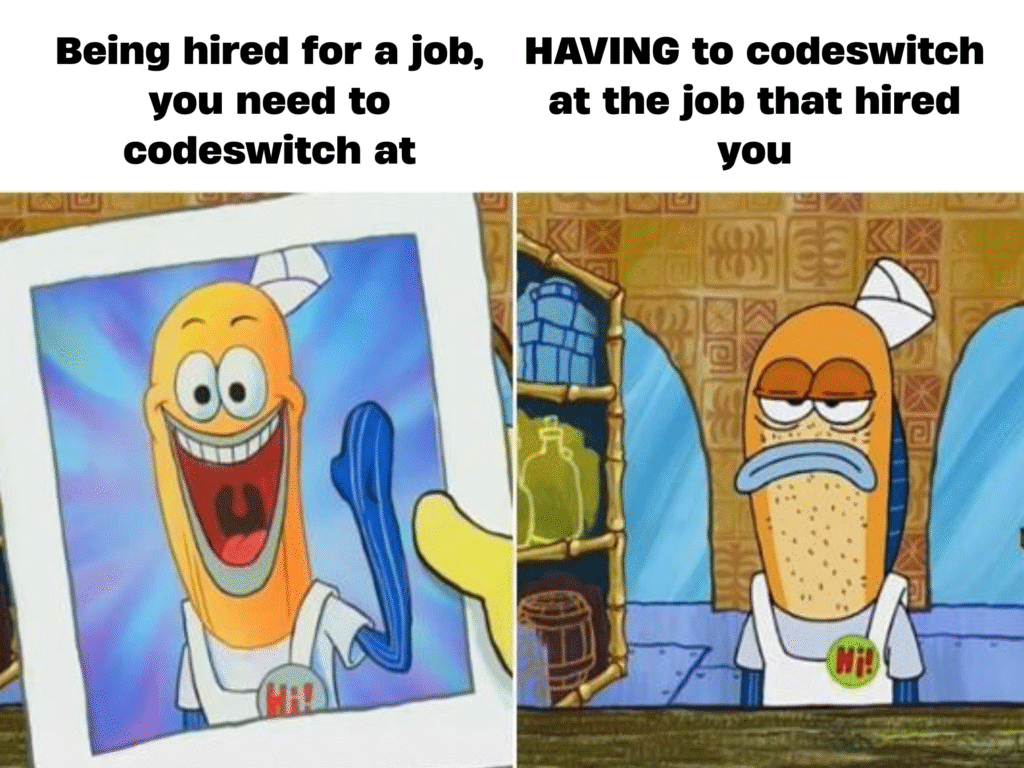
At the end of the day, I feel I made a great effort in getting my point across on how I feel about code-switching. Be it through this paper or the images, my stance on the topic is very clear. Being an issue I personally dealt with and one I’ve seen many loved ones also go through, it lit a fire in me, and I poured that emotion into every choice I made, from word choice to format. I hope this paper can help you see things from my side of things. Enough of my ranting, buckle up to witness the massacre of code-switching.
Unmasking Code-switching
People often wear masks to conceal their true identity for various reasons. Some reasons include the following: as a disguise to enter places they think they don’t belong or to hide things about themselves they’re ashamed of. Speech can also wear a mask for the same reasons people do. The mask speech wear is known as code-switching. Also, the common demographic that masks their speech are my Black brothas and sistas, sometimes unknowingly or pressured by society. This essay explores code-switching in corporate settings, deconstructing the positive notions and highlighting its downsides, while encouraging alternatives.
Code-switching, what’s that
Code-switching is an adjustment made by a person that can be done verbally, physically, or simultaneously. Physical code-switching involves changing your appearance, behavior, and expressions. Verbal code-switching involves swapping between two forms of communication. This includes languages, dictates, and tones. A bilingual person might code-switch between languages when translating in a conversation. While for an African American, it is different. For them, code-switching is between two forms of English, Black English, AKA African-American Vernacular English (AAVE), and standard English.
Why do African Americans Code Switch at work
Before a thing can be picked apart for its worth, an understanding of why it’s done needs to be established. African Americans code-switch in many aspects of their lives due to it being instilled into them at a very young age. Code-switching acts as a tool to advance socially. While later in their lives, it evolves into a protective measure, similar to chameleons changing their colors to avoid harm. African Americans change themselves, notably when interacting with law enforcement. The reasons for advancement and protection also apply to the reasons for code-switching in the workplace, even though characteristics tied to your race shouldn’t affect employment. The Harvard Business Review, a collection of articles, focuses on educating and creating interest in multiple aspects of business that have personal and professional effects on an individual. Narrowed down three main reasons for why Black people code-switch in the workplace; according to research,
- Downplaying membership in a stigmatized racial group helps increase perceptions of professionalism and the likelihood of being hired
- Avoiding negative stereotypes associated with black racial identity (e.g., incompetence, laziness) helps black employees be seen as leaders.
- Expressing shared interests with members of dominant groups promotes similarity with powerful organizational members, which raises the chance of promotions because individuals tend to affiliate with people they perceive as similar. (McCluney et al.2019)
The essence of The Harvard Business Review’s argument is that distancing oneself from one’s racial identity in favor of assimilating to the majority is crucial for professional advancement. On the surface, this may seem reasonable to some people. In reality, it sends the notion that working in a place that doesn’t accept you is okay, as long as you change yourself. That ideology is flawed. Black people shouldn’t be prohibited from navigating upwards in corporate America due to things that are tied to their race, ie, speech. The things that measure their ability should work. Workers shouldn’t feel the need to mitigate the chances of being tied to microaggressions because they shouldn’t be thinking that their coworkers will be doing that in the first place. Lastly, this encourages Black people to pander to higher-ups instead of working on themselves to showcase their abilities for the position, or forming actual bonds that can provide them with more benefits aside from work. You reduce yourself to a bootliker scurrying around for crumbs. Code-switching isn’t a tool that helps Black people progress in corporate environments; it keeps discriminatory beliefs thriving.
AAVE, provocative?
Another reason why we make this switch is due to a negative outlook on AAVE. To really understand the point, let’s hear from a member of the community. ROLL THE CLIP
Wow, from the mouth of the people. Code-switching ain’t a thing; it’s just adapting to professional settings. This was a clip from a video titled Do All Black Men Think The Same? | Spectrum, from the channel Jubilee. The core of the channel is to get groups of people from different walks of life and have them share and debate opinions regarding prompts. While I do agree you can’t just walk into work and say fuck or shit, even yo what’s good my nigga. This idea of cussing is all AAVE is, comes from a flawed mindset that makes people view the language as something taboo and that can’t be used in certain areas of life. June Jordan, professor of undergraduate Black English at Stony Brook University, in her essay “Nobody Mean More to Me Than You And the Future Life of Willie Jordan”, argues that Black English has structure and rules compared to the popular notion that it is broken English. Jordan supports her claim by providing rules, guidelines, and examples to showcase to readers the things they need to understand Black English.
Rule 1: Black English is about a whole lot more than mothafuckin.(Jordan, 1988,p.366)
Following a discussion where a student expressed that the version of Black English they were studying felt flawed due to missing cussing, Jordan expressed to him that it was more of a personal choice, not the language itself. So let’s go back to ol’ boy saying AAVE is unprofessional because it’s just cussing. That’s irrelevant. The language isn’t just profanity itself; profanity is a part of it, just like any language. You water down the true beauty and uniqueness of black English when labeling it as just cussing. So the notion around code-switching to avoid provocative language just shows you truly don’t know your language.
Why this might be a good thing
Every coin has an opposite side, so let’s play devil’s advocate. What are some of the benefits of code-switching? Well, the blog Blue Lynx’s goal is to enhance growth, value & opportunities for continued individual, client, and company success. They have an article where they discuss many aspects of code-switching and make an argument for the benefits. They argue that code-switching allows employees to showcase their adaptivity in various settings. This is a double whammy for not only the employee who presents themselves as a valuable asset to the company, but also opens more doors for the company to expand internationally. Code-switching promotes inclusion for all parties by removing the nuances present in certain forms of speech, while also providing all participants in the conversation with an accurate explanation of ideas. Also, this switch improves the relationship between colleagues by establishing respect for backgrounds, which can boost collaboration and teamwork(Blue Lynx, 2024). Well, that just seems to be so peachy. You make yourself a reliable colleague and a reliable employee. I mean, you’re turning yourself into the ultimate team player. Who wouldn’t want to be that type of person, right? Proving your worth to a company by pretending to be someone else, while they reap all the benefits from this performance. Then you have that bit about inclusion, how inclusive can code-switching be when it doesn’t accept diversity but instead waters it down to a more palatable standard speech pattern. Don’t even get me started on respect. There is no respect for background, because why can’t they express themselves in a way that reflects that background? When all of this is put out on the forefront, the flaws totally dismantle the so called “pros” of code-switching. Benefits, man, please.
The negative reality
We looked at the so-called positives of code-switching that contribute to this delusion that it is a useful tool. I’ve already started chipping away at the false reality, but the nail in code-switching’s coffin comes from these personal statements. Rawn Santiago, Nchopia Nwokoma, and Jasmin Crentsil, all university students, held an experiment where they enlisted the help of Black director-level employees from various fields and interviewed them in the span of an hour regarding “experiences with authenticity and assimilation at work as well as the implications for doing so over the course of their careers”(Santiago et al. 2021, pg 74) ). Answers were grouped based on similarities and documented verbatim. I want you to hear the voices of the participants categorized under Impact of Assimilation on Well-Being.
“frustrating, saddening often. It made me want to leave the
country, I’ll tell you that.”(Santiago et al. 2021, pg 75)
“It is constant. It is fatiguing, it wears you down daily. You come home so tired. Although I haven’t been working out for three hours, my brain has been working for eight hours. I just want to come home and sit down and relax. It wears you out. I am retiring early because of that.(Santiago et al. 2021, pg 76)
“At best it just makes you feel tired I think that it manifests in some mental health concerns, because you can’t be who you are or who you want to be.(Santiago et al. 2021, pg 76)
Mind you, there were even more things touched on in this section, including “experiencing anxiety, inability to sleep, relationships being negatively affected, feeling helpless, feeling exhausted, and experiencing self-doubt. Multiple respondents reported realizing the workplace was not meant for them to bring their full selves to work. As a result, they contemplated exit strategies, including quitting their job.”(Santiago et al. 2021, 76) This is just proving that code-switching has mentally taxing effects on people. It is literally stealing their life to the point where they crave sleep or freedom. This “survival tool” is also damaging to the psyche, causing identity crises due to switching personalities. On top of that, it also puts employees in a constant state of paranoia that their income is on the line, which creates stress-caused health issues. Things get so bad that relief is achieved when they quit. It should never get to the point where a place of employment can cause life altering damage to a person based on biases held towards speech. This isn’t a thing that positions Black people higher in corporate America; it chips away at the person until they are molded into this ideal image or crack under the pressure being applied.
Alternates
Code-switching is the bottom of the barrel option when it comes to communication. Honestly, why would you go for code-switching when code meshing exists. I’mma let my brotha, Vershawn Ashanti Young, author of Should Writers Speak They Own English, which argues against the conforming of language and instead embraces uniqueness, through picking apart the opposing side using examples of evidence. Take the mic. “code meshing blends dialects, international languages, local idioms, chat-room lango, and the rhetorical styles of various ethnic and cultural groups in both formal and informal speech acts”(Young, 2011, p. 67). So instead of flip flopping between languages, you can take a bit of this, a pinch of that, and boom, you’ve got yourself a communication style that incorporates you in it. This is code-switching 2.O! It allows these languages to coexist without a hierarchy between them; all I’m hearing is that you get the same benefits without the repercussions of code-switching. Code meshing is a respected form of communication that highlights the uniqueness of the speaker’s voice instead of shunning it. Being used by a range of professionals whose communication is the heart of their job: politicians, professors, journalists, and advertisers (Young, 2011, p. 67). It shows people who are scared that this option isn’t appropriate. It clearly is. Also, Vershawn Ashanti Young shone a spotlight on the importance of your voice by referring to Linguist William Labov’s 1970s discovery, while Black students were being humiliated for engaging in Black English, that same English was better received when communicating narrations, reasons, and debates to the same audience as their white middle-class counterparts(Young, 2011, p. 71). This showcases that there is value in the things you have naturally, so instead of trying to fit in with the masses, find the space where your talents are useful while also keeping them around. And unlike code-switching, which would have suppressed that voice, codemeshing includes it.
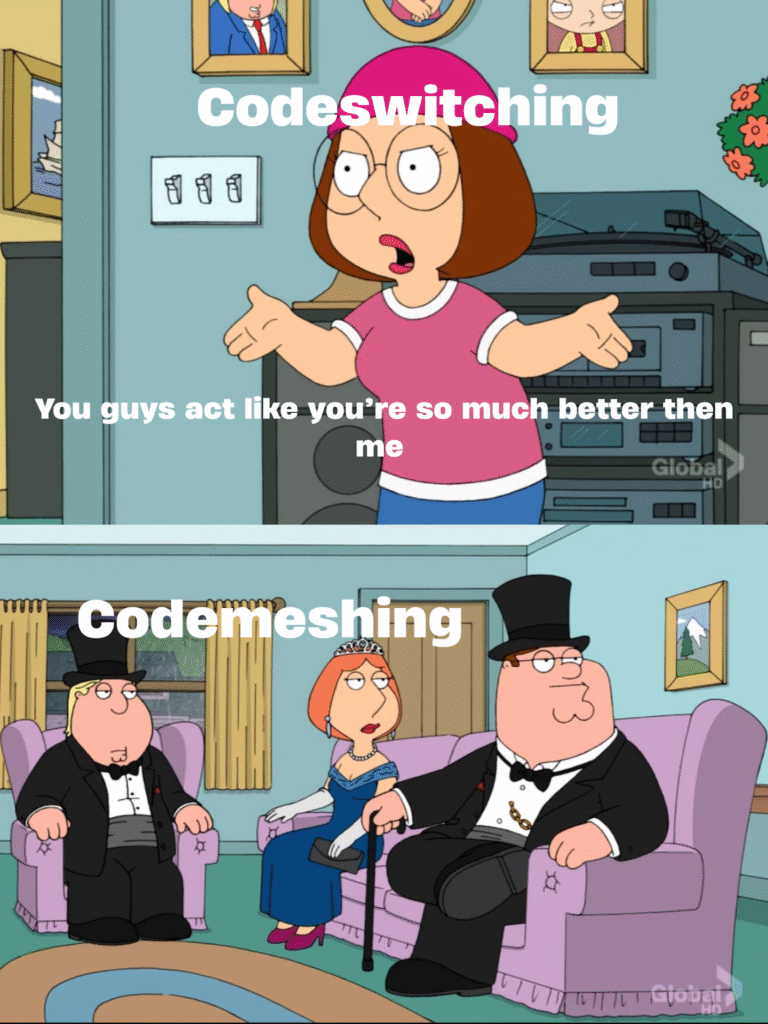
Code-switching has numerous downsides despite the benefits when it comes to African Americans in a corporate setting. From sewing seeds of self hate into their minds and upholding discriminatory beliefs. To, causing mental burdens for employees, which they need to be freed from, because of expectations and a draining environment. Some still believe that a slight chance of getting into the higher-ups’ good graces, getting a promotion, or boosting the company’s reach is worth this. Even though some alternatives allow African Americans to express their true self while also pleasing their employers. When it boils down to it, there is no reason why a person should sacrifice themselves for a sliver of respect and dollars.
Bibliography
Blue Lynx. (2024, July 15). Code-Switching in the Workplace: Balancing Communication Dynamics – Blue Lynx. Retrieved from Blue Lynx website: https://bluelynx.com/blog/code-switching-in-the-workplace-balancing-communication-dynamics/
Iles, B. (Director). (2011). Seahorse seashell party. Hulu.
Jordan, J. (1988). Nobody Mean More To Me Than You And the Future Life of Willie Jordan. Harvard Education Review, 58(3).
Jubilee. (2025, August 10). Code-switching is in the spotlight on #spectrum #codeswitch. Retrieved October 30, 2025, from www.youtube.com website: https://www.youtube.com/shorts/5_KN1qCjti0
McCluney, C., Robotham, K., Lee, S., Smith, R., & Durkee, M. (2019, November 15). The Costs of Code-Switching. Retrieved from Harvard Business Review website: https://hbr.org/2019/11/the-costs-of-Code-switching
Osborne, K. (Director). (2002). Party pooper pants. Nickelodeon.
Santiago, R., Nwokoma, N., & Crentsil, J. (2021). Investigating the implications of code-switching and assimilating at work for african american professionals. The Journal of Business Diversity, 21(4), 72-81. Retrieved from https://www.proquest.com/scholarly-journals/investigating-implications-code-switching/docview/2608160442/se-2
Young, V. A. (2011). Should Writers Speak They Own English. Utah State University Press.

This entry is licensed under a Creative Commons Attribution-NonCommercial-ShareAlike 4.0 International license.

