Hello Reader, how’s it going? This is my first time writing a language and literacy narrative, and all in all, it was fun. This writing made me reflect on my life and the way rhetoric I encountered, be it verbal or written, encompasses me as a person. Many moments came to mind when figuring out my topic of choice. Some I experienced in school, others just in daily life. In this essay, I relived an experience that flipped my whole world upside down. Exploring the hierarchy present in language and how it can go unknown until your environment is disrupted. Also, the way one’s community can develop a unique understanding that only the community’s members understand.
This piece is an expression of a major portion of me. While reading, you may see some rules broken or things that don’t follow what “standard writing” should look like. Those things are not mistakes. They’re choices. You are going to be introduced to a word I have heard my whole life. If you are from New York City, first of heyyy, but second, you probably know the word and will be just as shocked by my discovery. If you are from somewhere outside of the five boroughs, enjoy the ride of my rollercoaster of emotions. My essay is for people who have a dialect or an interest in dialects, so I wrote this in a way to showcase my dialect. Some things I want all readers to do is take what I’m writing about and see if there is a similarity in your life, or question something that you think is a common saying, and see if it is.
Closing out phase one is bittersweet. While I’m happy to progress further in the class, it is sad to see it end, but I have gained some useful insights from this period. One being that language and literacy are vast topics. Simple things that don’t seem that important can be monumental moments of language and literacy for others. Another insight this project provided was on the various ways language and literacy can be presented, from writing it in essay form to reenacting the moment, turning it into a poem, and even performing it as interactive theater.
Life is full of experiences that come with lessons attached, and the lessons I learned from this experience are the following. Context can bring clarity to any genre of text you are reading. Knowing the background of an author can show you many things about the writing, or even knowing the publisher can give you ideas about what the texts are trying to convey. Exigence, a new term to expand my vocabulary, which means the issue that prompted the text to be written. Lastly, the audience taught me a major lesson about myself. It showcased how I don’t really write with a select audience in mind. I write with the intention of getting my message through in a way that I feel is clear and creative. Looking forward, I’ll try to develop an audience at the start of my writing process to see the differences it makes in my writing.
Enough of my rambling, I hope that my essay leaves some type of impression on you and that it is an enjoyable experience.
Brolic Isn’t a Real Word ?!
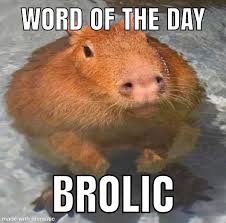
“So when was yall going to tell me brolic is not a word?” The statement played through the speaker of my phone, a thick New York accent bounced off the cream colored walls. This snapped me out of my mindless scrolling on TikTok, causing me to sit up on my plush bed. Frozen on my phone was a woman who could have been in her twenties or late thirties at the most. She had long blonde braids, a nose ring, and some collarbone tattoos. She made comedy videos about being from New York City and current things going on in the city that both me and my mom enjoyed. Once I unpaused the video, she continued. “All my life I’ve been saying brolic, and no one was going to tell me what’s up… that’s crazy.” “Here I am thinking everyone knows what brolic means, but nah, it’s just a New York thing.” Then the video started from the top, looping again.
In shock, I was left sitting there looking stupid. How did I not know it’s not a “real” word? Why did no one tell me brolic is slang? I used this word so many times that I can’t even count. I was so confident that I could tell the difference between slang and “real” words. I mean, that’s why I talk one way and write another. Are there other fake words I’m using without knowing? Is this common knowledge that I missed out on, or are there more people just like me? All of these thoughts filled my head, but the last one stuck out the most.
With a quick couple of scrolls through the comment section and searching up “ Brolic isn’t a real word”. I was able to see that the confusion was not only universal but also intergenerational. It’s like everyone living in this city, made up of five boroughs, thought the term was a part of the English language, until they were informed it’s not. It was so strange how we all used this term in the same context, and all had similar answers about its meaning.
Brolic: used to describe something as really muscular, strong, or big
While this experience made me question myself, it also made me question and reflect on English in general. What are words? When I think of words in this sense, I think of the building blocks a language uses to communicate verbally. Then, an even bigger question came to my mind. What makes a word “real”? Is it only “real” when it’s placed in a fancy dictionary that receives the praise of many. Or when a bunch of scholars agree that certain sounds used in a certain structure have a certain meaning.
Sharp pressure invaded my head, like I tried to squeeze every drop of juice out of my brain to answer these questions. So, I decided to let go of these thoughts. The pitter patter of my bare feet against the light and dark gray speckled tiles echoed through my apartment. I made my way to my mother, who was lounging on the wrinkled brown couch, to use more fake words when I talked to her. The discovery I made on that day didn’t erase any of the slang I use when speaking to others. It did, however, open my eyes to the effects that hierarchy in language has on the masses. This distinction of words being real or fake is very detrimental to communication as a whole. It makes the use of languages that are born from people from a specific area seem shameful. This can come in the form of embarrassment or even constant nitpicking of a person’s speech. The result of the negative outlooks due to this division can be the death of many beautiful and unique dialects that branch off from standard English. So I keep speaking these fake words because I refuse to let others erase a part of me that is unique, and I encourage others to do the same.

This entry is licensed under a Creative Commons Attribution-NonCommercial-ShareAlike 4.0 International license.

